How do elephant families raise their calves?
Elephant calves are raised by whole family groups, not only their mothers. Mothers supply milk and protection, while other females, called allomothers, help care for calves and give young females practice in mothering.
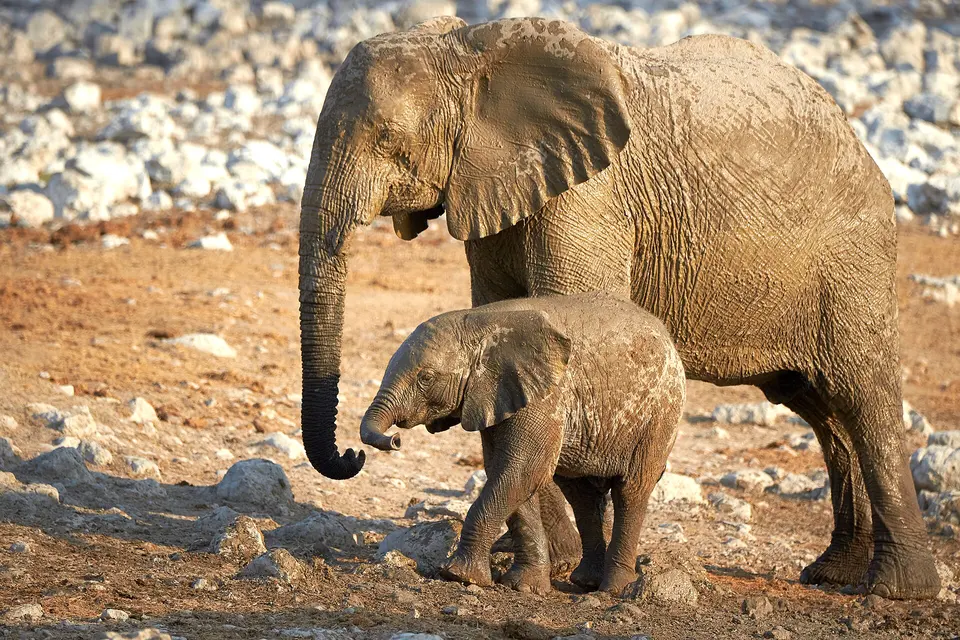
A calf enters a social world
An elephant calf is born into more than a relationship with its mother. In many elephant societies, female relatives travel and interact in family groups that provide a broad social setting for developing young. Mothers remain central, supplying milk, protection and close physical contact, but other females often participate in care. The ElephantVoices account of social learning describes elephant families as multigenerational environments in which youngsters learn by watching and interacting. This matters because an elephant must master far more than walking and feeding. It must recognise family members, interpret signals, find appropriate food and respond to danger. These skills develop through years of experience. Although each calf and herd is different, the importance of lasting family bonds is one reason researchers caution against treating elephants as interchangeable individuals in wildlife management.
Mothers provide food and a safe base
Calves depend on their mothers for milk in early life and gradually practise eating vegetation. ElephantVoices notes that suckling continues for approximately two years, while calves sample foods eaten by older animals during the transition. A young trunk is not instantly adept at gathering plants or manipulating unfamiliar objects. Practice occurs in the middle of normal herd activity, with an attentive adult often close enough to intervene. A mother may respond to distress calls and guide a calf as the herd moves. Breastfeeding and maternal support are particularly important because a very young calf cannot simply replace its mother's milk by following adults to forage. Nutrition and social learning therefore develop together. A calf's growing independence does not mean its need for family connection ends when nursing begins to decline.
Who are the allomothers?
An allomother is a female who provides care to a calf that is not her own. In elephant families, older sisters and other juvenile or adult females may accompany, touch, guide or guard younger animals. The ElephantVoices research overview says juvenile females learn vital mothering skills by caring for other mothers' calves, gaining experience before their own first calf. Allomothering is not the same as replacing the mother. The mother remains a particularly important source of milk and attachment, while helpers enlarge the calf's network of care. Watching young females interact with calves also shows why a family group is more than a collection of animals sharing space. Individuals contribute differently depending on age, experience and relationships. Not every female participates equally, and a snapshot cannot reveal all the bonds within a herd.
Learning the rules by watching others
Elephants navigate a complicated social landscape. A calf learns whom to approach, which adults provide reassurance and how to respond to unfamiliar individuals. By following older animals, it can learn feeding routes and observe reactions to other elephants or possible hazards. ElephantVoices explains that recognition, foraging knowledge and social conduct develop through observation and repeated interaction. It also describes youngsters sampling partly chewed food from older elephants, an example of learning connected directly to eating. Calling this process social learning does not require assuming adults deliberately teach every action. Sometimes a calf copies behaviour; sometimes another elephant actively intervenes. Either way, the family supplies repeated opportunities that an isolated youngster cannot easily reproduce. That is a powerful reason to preserve natural herd relationships.
Play and help during moments of trouble
Calves spend time exploring, chasing and interacting with others. Play can help young animals practise coordination and social responses, although it would be an overstatement to assign a single purpose to every playful moment. The ElephantVoices ethogram documents interactions in which an allomother intervenes when play becomes rough. Such observations give a practical picture of how protection can work: an adult need not be the calf's mother to notice and respond. During travel or a perceived threat, staying close to more experienced elephants also helps calves navigate their surroundings. Observers should avoid projecting precise human emotions onto every touch or trumpet. Researchers build interpretations from patterns recorded repeatedly, and herd responses may differ with environment and individual personalities. An individual calf's behaviour should be read in relation to the group. A young animal investigating vegetation may be exploring confidently, while a calf repeatedly seeking its mother may be responding to a change in the environment. The herd's movement and reactions provide important clues. Careful observation over time is more informative than attaching a dramatic interpretation to one interaction. Such patience is essential for responsible elephant education and conservation reporting.
What happens when families are disrupted?
Separation can affect far more than one animal. The Elephant Charter from ElephantVoices emphasises enduring attachments and the importance of family members in healthy calf development. Removing a mother, older sister or experienced female can reduce social support and access to behavioural models. This is relevant to poaching, capture, conflict and habitat fragmentation. It also has implications for welfare decisions in managed settings, where space and group composition influence opportunities for natural social interaction. Conservation is not simply about ensuring a species survives on paper. It involves safeguarding conditions in which its animals can live and develop normally. Visitors can help by observing from suitable distances, avoiding deliberate disturbance and supporting reputable organisations that protect wild habitat and family groups.
Frequently asked questions
Do elephant mothers raise calves alone?
Usually not in family groups; other females often provide support.
What is an allomother?
A female who helps care for another female's calf.
How do calves learn what to eat?
They watch and investigate foods used by older elephants.
Do calves need family after weaning?
Yes, social learning and relationships extend beyond nursing.
Is every elephant herd identical?
No. Family size, ages, relationships and circumstances vary.
Sources
Cite this page
APA
TuskWise. (2026, November 16). How do elephant families raise their calves? https://tuskwise.com/blog/how-do-elephant-families-raise-calves.html
MLA
“How do elephant families raise their calves?” TuskWise, 16 Nov. 2026, tuskwise.com/blog/how-do-elephant-families-raise-calves.html.
Chicago
TuskWise. “How do elephant families raise their calves?” TuskWise. Last modified November 16, 2026. https://tuskwise.com/blog/how-do-elephant-families-raise-calves.html.