How fast can an elephant run?
The fastest reliably recorded elephant speed is about 6.8 metres per second, roughly 25 km/h or 15 mph, measured in Asian elephants. That is close to a quick human sprint, and an elephant can keep it up over ground that would trip a person. But elephants never gallop and never leave the ground with all four feet at once. Instead they use an unusual fast gait that looks like a hurried walk from the outside while working like a run inside the legs.
The short answer
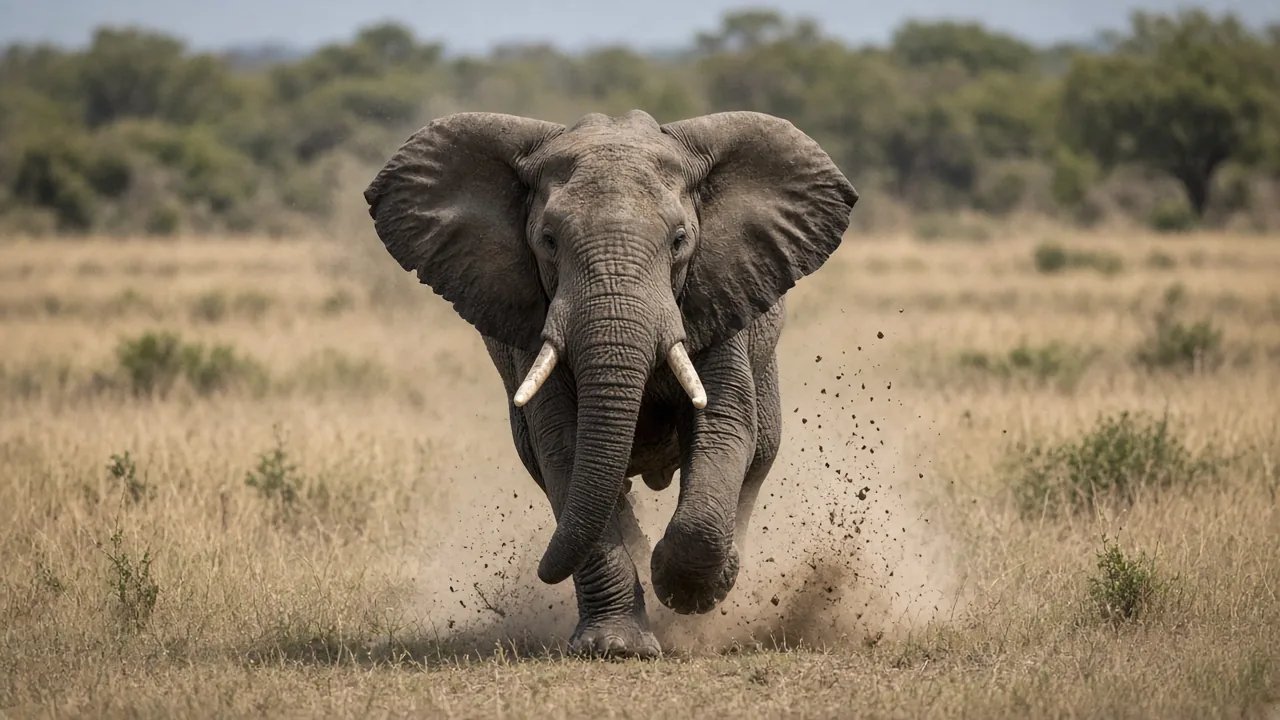
An elephant can move at about 25 km/h (15 mph) at its fastest. That figure, 6.8 metres per second, is the top speed reliably recorded for elephants, and it comes from careful video measurements of Asian elephants. You will see higher numbers online, sometimes 40 km/h, but none of them has been backed by a proper measurement. What makes elephant speed interesting is not just how fast they go but how they do it: an elephant at full speed never has all four feet in the air, so by the everyday definition it never runs at all. By the physicist's definition, it does.
How scientists measured elephant speed
Timing a charging elephant in the wild is neither easy nor safe, so for a long time estimates were little more than guesses. In 2003 John Hutchinson, Rodger Kram and colleagues tackled the question directly. Writing in Nature, they filmed Asian elephants moving across open ground at a range of speeds and used video analysis to track their bodies and limbs. The fastest elephants reached 6.8 m/s, about 25 km/h. The team noted that elephants are generally thought not to run, and that there had been real confusion about both their top speed and the gait they use to reach it.
Three years later the same group published a much larger data set in the Journal of Experimental Biology. They analysed more than 2,400 strides from 14 African and 48 Asian elephants weighing between 116 and 4,632 kg, over a 17-fold range of speeds from a slow 0.4 m/s stroll to that 6.8 m/s maximum. It remains the most complete record of how elephants move.
Walking, running, or something in between?
Most four-legged animals change gait as they speed up. A horse walks, then trots, then gallops, and in the gallop there is a moment when no foot touches the ground. Elephants do not do this. The 2006 study found that elephants use the same lateral sequence footfall pattern at every speed, simply shifting the timing so that the four feet strike the ground at more evenly spaced intervals as they go faster. They never switch to a gait in which the whole body is airborne.
That is why a fast elephant looks like it is power-walking. But looks can mislead. Biomechanists define walking and running by what the body's centre of mass does. In a walk, the body vaults over a stiff leg like an upside-down pendulum, rising as it slows and falling as it speeds up. In a run, the legs compress and spring back, so the body is lowest in the middle of each step, like a bouncing ball or pogo stick.
A 2010 study by Julien Genin, Norman Heglund and colleagues put 34 Asian elephants over force platforms at speeds from 0.4 to 5.0 m/s. At slow speeds the elephants used the pendulum exchange of a walk, with the greatest energy saving at about 1.4 m/s. At high speeds they switched to a bouncing mechanism, the hallmark of running, but still without an aerial phase. They also found that elephants need only about a third of the mechanical work per kilogram per metre that the average smaller animal needs to move its body along.
Bouncy back legs, stiff front legs
Lei Ren and John Hutchinson added a twist in 2008 in the Journal of the Royal Society Interface. They fitted African and Asian elephants with sensors and recorded hundreds of continuous strides in the field, measuring how the body moved in three dimensions. Both species moved very similarly. Near the most economical speed, the inverted pendulum of walking dominated. As the elephants went faster, their movement shifted smoothly and continuously from vaulting toward bouncing, rather than changing in one sudden step.
Surprisingly, the hind legs started acting like pogo sticks at only about 2.2 m/s, around 8 km/h, while the front legs stayed relatively stiff and kept vaulting. The authors concluded that elephants are not as rigid-limbed as they are often described, and that they use ordinary walking plus at least one form of running gait. The 2006 kinematics study pointed the same way: at faster speeds the hind legs compress more, and this extra give probably helps keep peak forces on the bones relatively low.
Why elephants don't gallop or jump
Size is the main reason. As an animal gets bigger, its weight grows with its volume, but the strength of its bones and tendons grows only with their cross-sectional area. Genin's team point out that this makes very large animals relatively more fragile than small ones. Landing a five-tonne body after a flight phase would put huge loads on the limbs, so elephants move fast while always keeping at least one foot planted. Their pillar-like legs and padded feet, described in our anatomy guide, are built for support and endurance rather than leaps.
This is also why elephants cannot jump. There is no gait in their repertoire that lifts all four feet off the ground, and nothing in their skeleton is built to absorb that kind of landing.
Calves are more athletic than adults
Young elephants are not simply small adults. The 2006 study found that smaller elephants, including those under 500 kg, move in much the same way as adults but are relatively more athletic. At any given speed they take relatively quicker and longer strides, and near top speed they reach higher Froude numbers, a size-adjusted measure of speed. That probably means their limbs experience relatively higher peak loads, produced more quickly, than the limbs of big adults. If you watch a herd on the move, the calves trotting to keep up are working their bodies harder than their mothers.
Speed isn't everything: elephants avoid hills
Being heavy affects where elephants go, not just how fast. In 2006 Jake Wall, Iain Douglas-Hamilton and Fritz Vollrath reported in Current Biology that GPS tracks of African savanna elephants, laid over digital maps of elevation and slope, showed the animals tend to avoid steep slopes. Lifting several tonnes uphill costs a lot of energy, and the authors argued that terrain gradient is an important, often overlooked factor in how elephants move through a landscape. It is one more reason the habitats elephants use, and the routes between them, matter for conservation.
The bottom line
Elephants top out at about 25 km/h, fast enough to match a quick human sprint. They get there without ever leaving the ground, using springy hind legs and stiffer front legs in a gait that is part walk and part run. For how African and Asian elephants differ in size and build, see our species comparison, and for more quick answers, browse the elephant FAQ.
Frequently asked questions
How fast can an elephant run?
The fastest reliably recorded speed is about 6.8 metres per second, or roughly 25 km/h (15 mph). John Hutchinson and colleagues measured it in Asian elephants using video analysis and reported it in Nature in 2003. Higher figures are often quoted, but they have not been measured reliably.
Can elephants jump?
No. Even at top speed, studies of thousands of elephant strides found that elephants keep the same footfall pattern and never switch to a gait with all four feet off the ground at once. Their great weight and pillar-like legs make a jump impractical.
Can you outrun an elephant?
Not reliably. Twenty-five kilometres per hour is about the speed of a fast human sprint, and an elephant can cover rough ground easily. If you meet an elephant in the wild, the safe approach is to keep your distance and follow your guide's instructions rather than plan to run.
Do elephants walk or run?
Both, in a sense. At slow speeds they walk like a pendulum. As they speed up, their legs act more like springs, which is the mechanical signature of running, even though their feet never all leave the ground. Scientists call this a running gait without an aerial phase.
Sources
- Hutchinson, J. R., Famini, D., Lair, R. and Kram, R. (2003). Are fast-moving elephants really running? Nature 422, 493 to 494. DOI 10.1038/422493a
- Hutchinson, J. R., Schwerda, D., Famini, D. J., Dale, R. H. I., Fischer, M. S. and Kram, R. (2006). The locomotor kinematics of Asian and African elephants: changes with speed and size. Journal of Experimental Biology 209, 3812 to 3827. DOI 10.1242/jeb.02443
- Ren, L. and Hutchinson, J. R. (2008). The three-dimensional locomotor dynamics of African (Loxodonta africana) and Asian (Elephas maximus) elephants reveal a smooth gait transition at moderate speed. Journal of the Royal Society Interface 5, 195 to 211. DOI 10.1098/rsif.2007.1095
- Genin, J. J., Willems, P. A., Cavagna, G. A., Lair, R. and Heglund, N. C. (2010). Biomechanics of locomotion in Asian elephants. Journal of Experimental Biology 213, 694 to 706. DOI 10.1242/jeb.035436
- Wall, J., Douglas-Hamilton, I. and Vollrath, F. (2006). Elephants avoid costly mountaineering. Current Biology 16, R527 to R529. DOI 10.1016/j.cub.2006.06.049
Cite this page
APA
TuskWise. (2026, October 20). How fast can an elephant run? https://tuskwise.com/blog/how-fast-can-elephants-run.html
MLA
“How fast can an elephant run?” TuskWise, 20 Oct. 2026, tuskwise.com/blog/how-fast-can-elephants-run.html.
Chicago
TuskWise. “How fast can an elephant run?” TuskWise. Last modified October 20, 2026. https://tuskwise.com/blog/how-fast-can-elephants-run.html.