Why do elephants throw mud and dust on themselves?
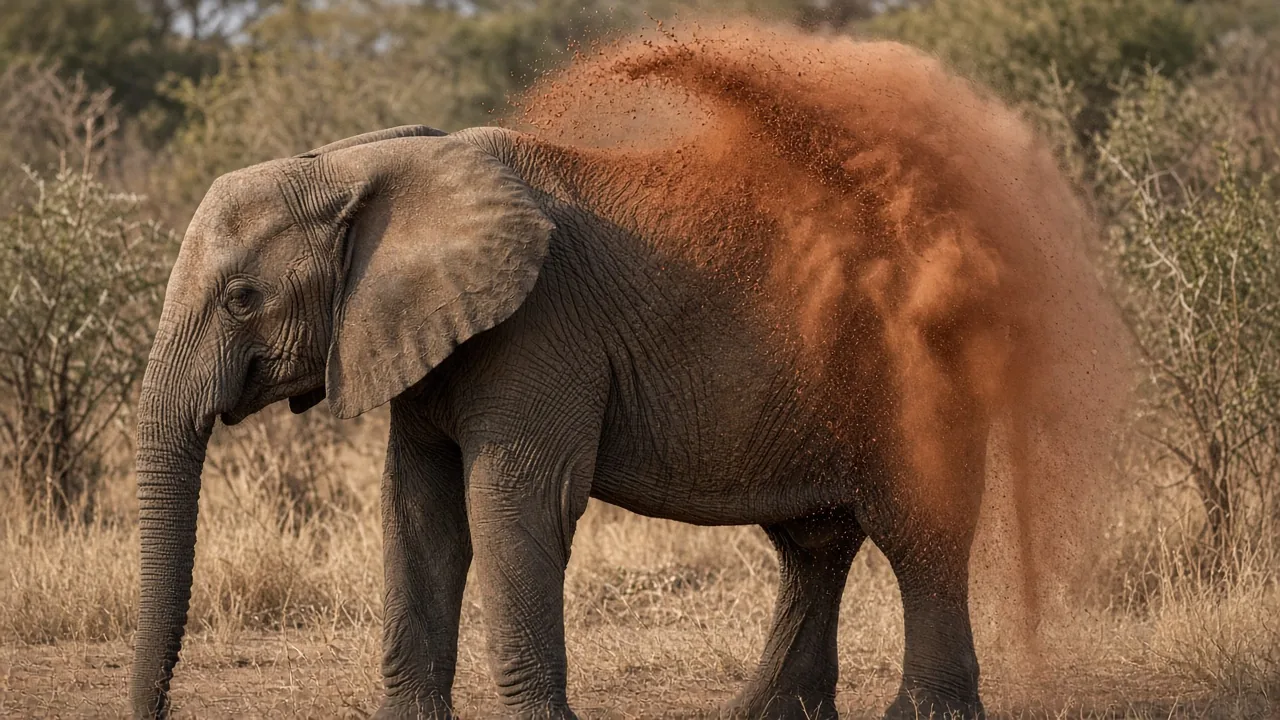
Elephants coat themselves in water, mud and dust mainly to stay cool and to protect their skin. They have no sweat glands to speak of, so they rely on water evaporating from their skin to shed heat, and a wet, muddy coat keeps that cooling going for longer. The deep cracks in an elephant's skin hold water and grip mud, and once the mud dries it acts as a sunscreen and a barrier against biting insects and parasites. Dust thrown over a wet back does a similar job.
The short answer
When an elephant sprays itself with water, rolls in a wallow or flings dust over its back, it is mostly managing heat and caring for its skin. Elephants are huge animals that make a lot of body heat, live in hot places and cannot sweat the way we do. Water on the skin cools them as it evaporates. Mud keeps that water in place for longer and, once dry, shades the skin from the sun and blocks biting insects. Dust adds another protective layer. It looks like play, and sometimes it is, but it is also essential body maintenance.
The heat problem of being an elephant
Big bodies hold heat. An adult elephant has a lot of mass compared with its surface area, so heat produced by digestion and movement takes longer to escape than it does from a small animal. In much of southern Africa, air temperatures in the hottest part of the day climb above an elephant's own body temperature, which means the animal can gain heat from its surroundings rather than lose it.
Elephants have several ways to cope. Their thin, blood-rich ears act as radiators, as we explain in why elephants have big ears. A 2010 study by Nicole Weissenböck and colleagues used infrared cameras on African elephants and found patches of the body surface, called thermal windows, that warm up as blood flow is directed there to dump heat. But the most powerful tool, especially on very hot days, is water evaporating from the skin.
Elephants don't sweat, so they wet themselves instead
Elephants have essentially no working sweat glands. In 1984 P. G. Wright and C. P. Luck asked a blunt question in the South African Journal of Zoology: do elephants need to sweat? Their answer was that they do not, because water moves through elephant skin and evaporates from the surface, and the structure of the skin and the animals' bathing behaviour help keep that water loss at the level needed to stay in thermal balance.
Later measurements put numbers on it. Robin Dunkin and colleagues, writing in the Journal of Experimental Biology in 2013, measured skin temperature and water loss through the skin in 13 zoo elephants, seven African and six Asian, at air temperatures from 8 to 33°C. Water loss through the skin rose steeply with heat, and the team concluded that elephants are obligate evaporative coolers: they must lose water to stay cool. Their models suggested that in a hot, dry climate the daily water cost of cooling can be more than 4.5 times higher than in a mild one. That is one reason elephants stay close to water, a pattern described on our habitats page.
Why wrinkles and cracks matter
An elephant's skin is not smooth. In 1987 H. B. Lillywhite and B. R. Stein reported in the Journal of Zoology that the deeply sculptured surface of elephant skin holds on to moisture after a wallow or bath. Water trapped in folds and crevices evaporates slowly, so the cooling lasts much longer than it would on flat skin, and the outer skin is kept from drying out.
In 2018 a team led by António Martins and Michel Milinkovitch looked closer at African savanna elephant skin using microscopy and CT scans. Writing in Nature Communications, they showed that the network of micrometre-wide channels covering the skin are actual fractures in the thick, brittle outer layer, formed as that layer builds up and bends over a lattice of tiny bumps. They note that these channels improve cooling by holding water and help protect against parasites and strong sunlight by helping mud stick. In other words, the cracked skin is built to work with mud. More on elephant skin and other body parts is in our anatomy guide.
What mud and dust add
Mud does two jobs. While wet, it carries water that keeps evaporating and cooling the skin. Once it dries, it forms a crust that shades the skin from solar radiation and makes it harder for flies, ticks and other parasites to bite. Elephants also rub against trees, rocks and termite mounds, which may help clean the skin, though this has been studied far less than cooling.
Dust bathing works in a similar way when there is no wallow nearby. Elephants often spray themselves with water first and then use their trunks to blow or throw loose soil over their backs and heads. The dust clings to the wet skin and fills the cracks. You can read more about everyday elephant routines on our behavior page.
What wild elephants do on hot days
Most of this research has been done on zoo animals, so a 2016 study in Conservation Physiology by Michael Mole, Andrea Fuller and colleagues is useful because it followed tame savanna elephants moving freely in their natural habitat in southern Africa during the hot part of the day. They found that heat shaped what the elephants did. Once black globe temperature, a measure of the total heat load from air and sun, reached about 30°C, the elephants shifted their behaviour to cut heat gain and boost heat loss, using shade more and wetting themselves. Resting, walking and feeding all changed with temperature. With these behaviours plus their body's own adjustments, the elephants kept a stable core temperature even when environmental temperatures went above 40°C.
The researchers concluded that elephants clearly can handle extreme heat, at least when they have enough food, water and shade, and that conservation planning should provide for those needs. As droughts and heat waves become more common, access to water and wallows is likely to matter even more.
The bottom line
Elephants throw water, mud and dust on themselves because they cannot sweat and need another way to cool their large bodies. Water evaporating from the skin carries heat away, the cracked skin holds that water and grips mud, and dried mud and dust act as sunscreen and insect repellent. For more answers about elephant bodies and behaviour, browse our elephant FAQ.
Frequently asked questions
Do elephants sweat?
Not in the way people do. Elephants have essentially no functioning sweat glands. Instead, water passes slowly through their skin and evaporates from the surface, and they add extra water by spraying themselves, wallowing and bathing. A study of African and Asian elephants in zoos confirmed they depend on evaporative cooling from the skin.
Why do elephants throw dust after bathing?
Dust sticks to wet skin and to the mud left after a wallow, adding a layer that shades the skin from the sun and makes it harder for biting flies and ticks to reach it. Elephants often spray water first and then blow or throw dust over their backs with their trunks.
Why is elephant skin so wrinkled and cracked?
The surface of African savanna elephant skin is covered with a network of fine channels. A 2018 study in Nature Communications showed these are fractures in the thick, brittle outer layer of skin. The channels hold water and help mud stick, which helps elephants stay cool and protects the skin.
Do elephants need mud wallows?
Wallows and water are an important part of how elephants cope with heat. A study of free-ranging elephants in southern Africa found they increased shade use and wetting behaviour once heat load rose, and the researchers said conservation plans should allow for elephants' needs for water, shade and space.
Sources
- Lillywhite, H. B. and Stein, B. R. (1987). Surface sculpturing and water retention of elephant skin. Journal of Zoology 211, 727 to 734. DOI 10.1111/j.1469-7998.1987.tb04483.x
- Wright, P. G. and Luck, C. P. (1984). Do elephants need to sweat? South African Journal of Zoology 19, 270 to 274. DOI 10.1080/02541858.1984.11447892
- Martins, A. F., Bennett, N. C., Clavel, S., Groenewald, H., Hensman, S., Hoby, S., Joris, A., Manger, P. R. and Milinkovitch, M. C. (2018). Locally-curved geometry generates bending cracks in the African elephant skin. Nature Communications 9, 3865. DOI 10.1038/s41467-018-06257-3
- Dunkin, R. C., Wilson, D., Way, N., Johnson, K. and Williams, T. M. (2013). Climate influences thermal balance and water use in African and Asian elephants: physiology can predict drivers of elephant distribution. Journal of Experimental Biology 216, 2939 to 2952. DOI 10.1242/jeb.080218
- Mole, M. A., Rodrigues DÁraujo, S., van Aarde, R. J., Mitchell, D. and Fuller, A. (2016). Coping with heat: behavioural and physiological responses of savanna elephants in their natural habitat. Conservation Physiology 4, cow044. DOI 10.1093/conphys/cow044
- Weissenböck, N. M., Weiss, C. M., Schwammer, H. M. and Kratochvil, H. (2010). Thermal windows on the body surface of African elephants (Loxodonta africana) studied by infrared thermography. Journal of Thermal Biology 35, 182 to 188. DOI 10.1016/j.jtherbio.2010.03.002
Cite this page
APA
TuskWise. (2026, October 19). Why do elephants throw mud and dust on themselves? https://tuskwise.com/blog/why-do-elephants-throw-mud-and-dust-on-themselves.html
MLA
“Why do elephants throw mud and dust on themselves?” TuskWise, 19 Oct. 2026, tuskwise.com/blog/why-do-elephants-throw-mud-and-dust-on-themselves.html.
Chicago
TuskWise. “Why do elephants throw mud and dust on themselves?” TuskWise. Last modified October 19, 2026. https://tuskwise.com/blog/why-do-elephants-throw-mud-and-dust-on-themselves.html.