How many muscles are in an elephant's trunk?
There is no single neat number, because the trunk is not built from a few big named muscles like an arm. In 2023, researchers who mapped every muscle bundle in the trunk of a baby Asian elephant counted around 90,000 muscle fascicles, the small bundles of fibres that make up a muscle, with about 8,000 in the tip and finger alone. The often repeated figure of 40,000 muscles is an older estimate. Either way, the trunk contains no bones at all: it is a muscular hydrostat, like your tongue or an octopus arm.
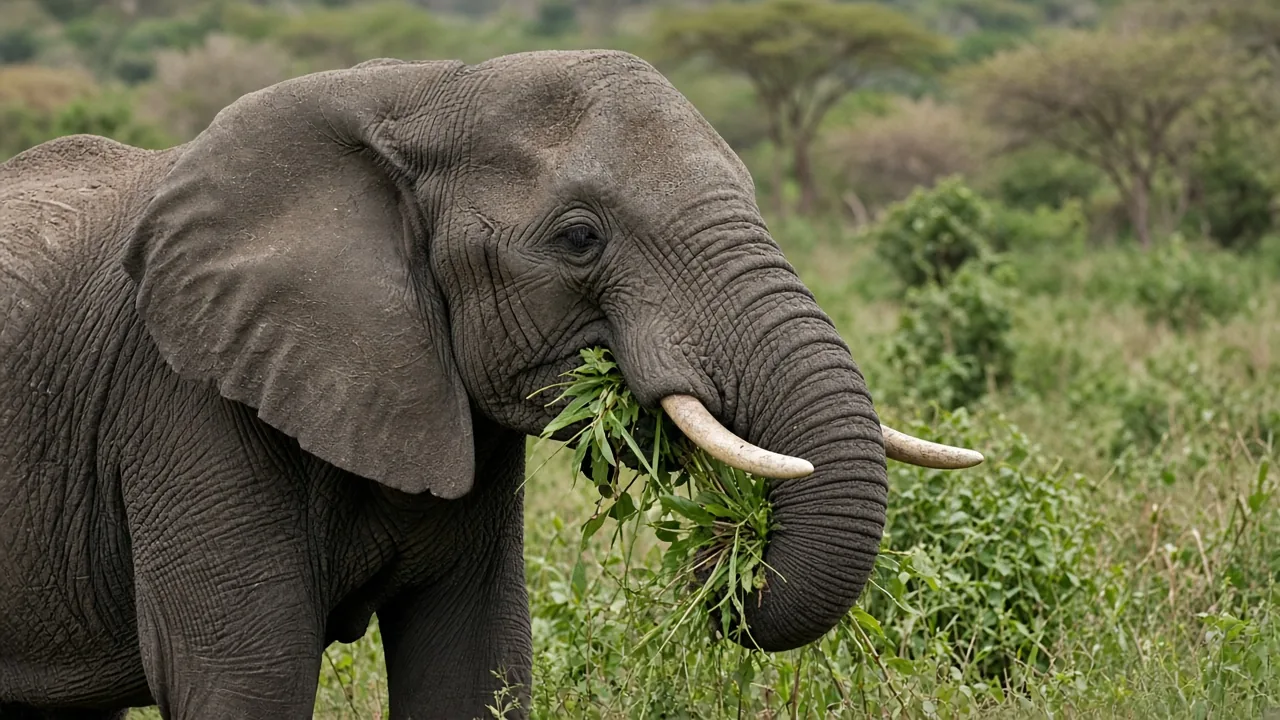
The short answer
Around 90,000 muscle bundles, if you count them one by one. In 2023, a team led by L. L. Longren and Michael Brecht published the first complete reconstruction of an elephant trunk's musculature in Current Biology. Working from microCT scans of the trunk of a baby Asian elephant, they traced every muscle fascicle, the small bundle of fibres that is the basic working unit of a muscle, and arrived at roughly 90,000. The trunk tip and its finger alone held about 8,000 of them.
You will often see the figure "40,000 muscles" quoted. That is an older estimate, and the authors noted that the number of trunk muscles had simply been unclear until someone did the painstaking count. Both figures tell the same story: the trunk is driven by what the researchers call the most complex musculature known in animals.
A trunk with no bones
The trunk is the elephant's nose and upper lip fused into one long organ, and it contains no bones along its length. Instead it works as a muscular hydrostat. Muscle tissue is mostly water and cannot be compressed, so when one set of muscles squeezes the trunk thinner, it has to get longer; when another set contracts along its length, it shortens or bends. Your tongue and an octopus arm work the same way.
Longren's team found three main kinds of fascicle. Long longitudinal and oblique bundles run along the trunk and bend or shorten it. Tiny radial bundles run from the centre outward and make the trunk thinner, which lengthens it. A small share of transverse bundles run across it. The mix changes along the trunk. In the tip, radial fascicles make up about 82% of the muscle volume, and the dexterous finger is made entirely of microscopic radial fascicles. The shaft has more dorsal than ventral radial muscle, which the authors suggest helps it stretch upward more easily and curl inward rather than outward.
The design is very different from a human hand. We control a fairly small set of large muscles with many nerve cells each. The elephant has thousands of microscopic muscle bundles, which the researchers think probably outnumber the nerve cells in the facial motor nucleus that controls them. For the bigger picture of how the trunk fits into elephant anatomy, see our anatomy guide.
One finger or two: African vs Asian trunks
African elephants have two finger-like lips at the end of the trunk, one on top and one underneath. Asian elephants have one upper finger and a rounded lower bulb. That difference changes how they pick things up. In a 2025 study in Communications Biology, L. Eigen and colleagues reconstructed the trunk tips of three African savanna and three Asian elephants. African trunk tips were about one third longitudinal muscle and two thirds radial and transverse muscle, which suits pinching objects between the two fingers. Asian trunk tips were the other way round, about two thirds longitudinal, which suits wrapping the trunk around an object or clamping it behind the tip. More species differences are on our African vs Asian elephant page.
A vacuum cleaner that weighs 100 kg
An adult trunk can weigh over 100 kg, yet elephants mostly eat light, fiddly vegetation. Andrew Schulz, David Hu and colleagues at Georgia Tech filmed African elephants at Zoo Atlanta and showed in 2021 that they can use suction to grab food, a behaviour previously thought to be limited to fish. Ultrasound showed the nostrils widening to increase the trunk's internal volume, and the team estimated elephants could inhale at over 150 metres per second, nearly 30 times the speed of a human sneeze. That was enough to hoover up piles of rutabaga cubes and fragile tortilla chips.
Earlier work by the same group, published in 2018, showed another trick. To pick up a pile of small food, an elephant presses down on it with its trunk, forming a joint that creates a vertical pillar up to 11 cm tall. It pushes harder on smaller pieces, squeezing loose particles into a solid lump it can lift. The study notes that wild African elephants eat around 180 grams of food per minute, which is why speed matters. We cover the daily totals in how much elephants eat and drink.
Wrinkles that help it stretch
The skin matters too. In a 2022 PNAS study, Schulz and colleagues asked African elephants to reach for distant objects and found the trunk does not stretch evenly. The upper side stretched about 15% more than the underside. Tests on skin from an elephant that had died showed why: the folded skin on top is 15% more pliable than the finely wrinkled skin underneath, and at that point the skin takes 13 times more energy to stretch than the same length of muscle. Skin folds protect the upper trunk and give way when the elephant wraps its trunk downward, its most common grip.
Whiskers and "trunkedness"
Elephant trunks are also highly sensitive. A 2023 study led by N. Deiringer found that whiskers are densest at the trunk tip, and that African savanna elephants have more tip whiskers than Asian elephants. Elephants do not sweep their whiskers like a cat; trunk movements decide what they touch. Strikingly, adult elephants showed whiskers worn down more on one side, caused by consistently favouring one side when using the trunk. Like left or right handedness in people, many elephants are left or right trunked. That fine control is part of why elephants are such capable tool users.
The bottom line
An elephant trunk has no bones and is powered by around 90,000 tiny muscle bundles, arranged differently along its length and between species. That lets one organ push over trees, suck up food at high speed, pinch a single grain and sense the world through whiskers. For more trunk facts, read about elephant behaviour, explore elephant intelligence, or browse the elephant FAQ.
Frequently asked questions
How many muscles does an elephant trunk have?
A 2023 study in Current Biology reconstructed the trunk musculature of a baby Asian elephant from microCT scans and counted around 90,000 muscle fascicles, the elementary bundles that make up muscle. About 8,000 of them are in the trunk tip and finger. The popular figure of 40,000 muscles is an older, rougher estimate.
Does an elephant trunk have bones?
No. The trunk has no bones or cartilage along its length. It is a muscular hydrostat: muscle squeezing against muscle and fluid lets it lengthen, shorten, bend and twist, the same principle as the human tongue and octopus arms.
How heavy is an elephant trunk?
An adult elephant's trunk can weigh over 100 kg, according to researchers at Georgia Tech who studied suction feeding at Zoo Atlanta. Despite that weight, elephants can use it to vacuum up fragile tortilla chips.
Can elephants suck up food with their trunk?
Yes. A 2021 study filmed African elephants using suction to pick up food, a feeding method once thought to be limited to fish. The authors estimated the elephant could inhale at over 150 metres per second, nearly 30 times the speed of a human sneeze.
What is the difference between African and Asian elephant trunks?
African elephants have two finger-like tips, one on top and one underneath, and tend to pinch objects. Asian elephants have one upper finger and a lower bulb, and tend to wrap the trunk around objects. A 2025 study found their trunk tip muscles differ to match these grips.
Are elephants left or right trunked?
Many are. Adult elephants show lopsided wear on their trunk whiskers caused by consistently favouring one side when using the trunk, a 2023 study of trunk whiskers found, similar to handedness in people.
Sources
- Longren, L. L., Eigen, L., Shubitidze, A., Lieschnegg, O., Baum, D., Nyakatura, J. A., Hildebrandt, T. and Brecht, M. (2023). Dense reconstruction of elephant trunk musculature. Current Biology 33, 4713 to 4720. DOI 10.1016/j.cub.2023.09.007
- Eigen, L., Ladenburger, P., Brence, B., Shubitidze, A., Baum, D., Hildebrandt, T. and Brecht, M. (2025). Elephant trunk tip musculature reflects species differences in grasping behavior. Communications Biology 8, 1779. DOI 10.1038/s42003-025-08998-6
- Schulz, A. K., Ning Wu, J., Ha, S. Y. S., Kim, G., Braccini Slade, S., Rivera, S., Reidenberg, J. S. and Hu, D. L. (2021). Suction feeding by elephants. Journal of the Royal Society Interface 18, 20210215. DOI 10.1098/rsif.2021.0215
- Wu, J., Zhao, Y., Zhang, Y., Shumate, D., Braccini Slade, S., Franklin, S. V. and Hu, D. L. (2018). Elephant trunks form joints to squeeze together small objects. Journal of the Royal Society Interface 15, 20180377. DOI 10.1098/rsif.2018.0377
- Schulz, A. K., Boyle, M., Boyle, C., Sordilla, S., Rincon, C., Hooper, S., Aubuchon, C., Reidenberg, J. S., Higgins, C. and Hu, D. L. (2022). Skin wrinkles and folds enable asymmetric stretch in the elephant trunk. Proceedings of the National Academy of Sciences 119, e2122563119. DOI 10.1073/pnas.2122563119
- Deiringer, N., Schneeweiß, U., Kaufmann, L. V., Eigen, L., Speissegger, C., Gerhardt, B., Holtze, S., Fritsch, G., Göritz, F., Becker, R., Ochs, A., Hildebrandt, T. B. and Brecht, M. (2023). The functional anatomy of elephant trunk whiskers. Communications Biology 6, 591. DOI 10.1038/s42003-023-04945-5
Cite this page
APA
TuskWise. (2026, October 25). How many muscles are in an elephant's trunk? https://tuskwise.com/blog/how-many-muscles-are-in-an-elephant-trunk.html
MLA
“How many muscles are in an elephant's trunk?” TuskWise, 25 Oct. 2026, tuskwise.com/blog/how-many-muscles-are-in-an-elephant-trunk.html.
Chicago
TuskWise. “How many muscles are in an elephant's trunk?” TuskWise. Last modified October 25, 2026. https://tuskwise.com/blog/how-many-muscles-are-in-an-elephant-trunk.html.