How much do elephants eat and drink?
An adult elephant eats roughly 75 to 150 kg of plant food a day, about 4 to 6% of its body weight, and drinks around 75 to 190 litres of water when it can, according to San Diego Zoo Wildlife Alliance and the Smithsonian. Feeding takes up about 16 hours of an elephant's day. The reason is not just size: elephants push food through their guts quickly and digest a relatively small share of it, so they make up for quality with quantity.
The short answer
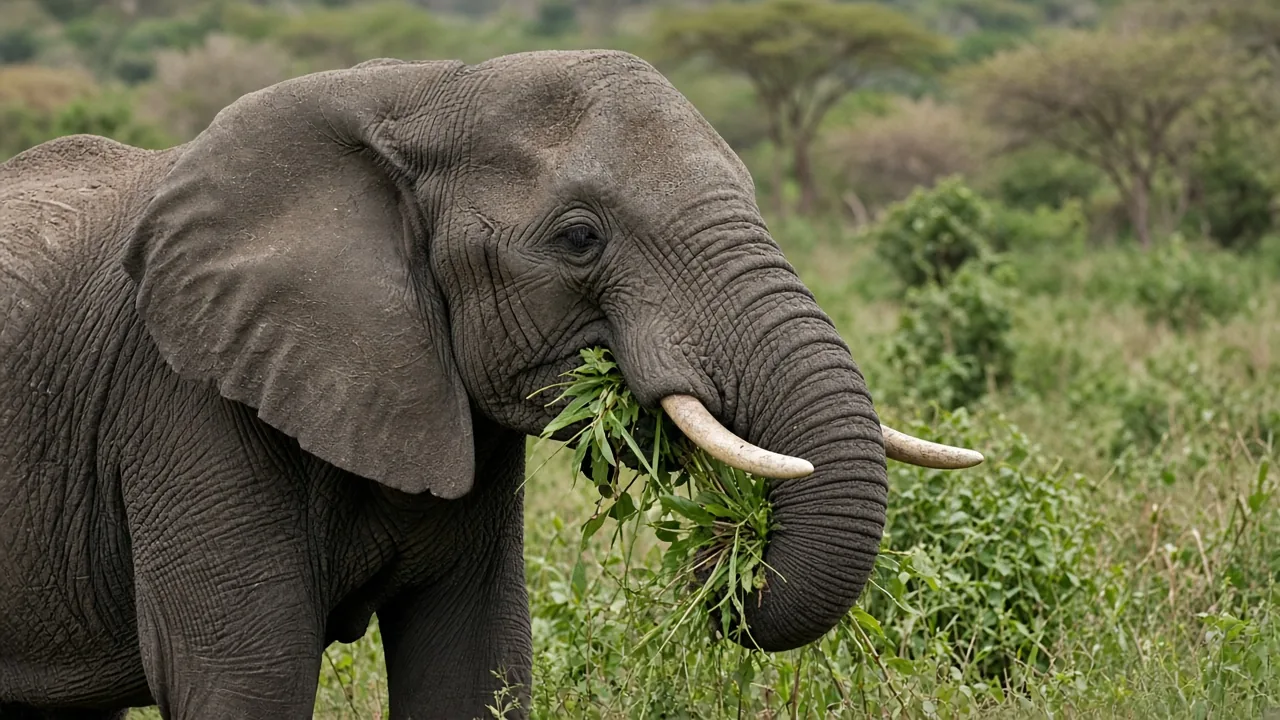
An adult elephant eats about 75 to 150 kg of plants a day and drinks roughly 75 to 190 litres of water. San Diego Zoo Wildlife Alliance puts the food figure at about 4 to 6% of body weight and says elephants spend an average of 16 hours a day eating. The Smithsonian gives about 189 litres of water a day for wild Asian elephants. To put that in kitchen terms, a big elephant eats the weight of two adult people in leaves, grass and bark every day, and can drink a bathtub of water.
Why elephants need so much food
Size is part of it, but not the whole story. Bigger animals need more food in total, yet they need less per kilogram, because their metabolism per unit of body weight is slower. In theory that should make a giant like an elephant a very efficient eater. In practice it is not.
Elephants are hindgut fermenters. Like horses and rhinos, they break down tough plant fibre with microbes in an enlarged colon and caecum, after the stomach and small intestine, rather than in a multi-chambered stomach like cattle and antelope. Marcus Clauss and colleagues, writing in Oecologia in 2003, argued that this design is one reason the very largest land herbivores, living and extinct, have been hindgut fermenters rather than ruminants: a hindgut system does not cap how much an animal can eat in the same way a foregut does, so a huge animal can keep food moving through at high volume.
Fast in, fast out: elephant digestion
The cost of that throughput is that elephants extract relatively little from each mouthful. In a second 2003 study, in the Journal of Animal Physiology and Animal Nutrition, Clauss and colleagues ran feeding trials with six captive Asian elephants on six different diets to see whether the horse is a good nutritional model for elephants. In many ways it was: the two species responded similarly to fibre and supplements, absorbed calcium in a similar way and produced similar fermentation products in their dung. But the elephants digested distinctly less of every nutrient than horses do.
The authors linked this to the much faster passage of food reported for elephants. Food spends less time in the gut, so the microbes have less time to work on it. The Smithsonian sums up the result as elephants digesting only about 44% of what they eat. That is why elephant dung is so fibrous, and why it is so useful to other animals, from dung beetles to birds picking out undigested seeds.
What elephants eat through the year
Elephants are not fussy in the sense of eating only a few things, but they are selective. In a classic study in southern India from 1981 to 1983, Raman Sukumar found that Asian elephants ate at least 112 plant species, yet about 85% of their diet came from just 25 species, mostly grasses, sedges, palms, legumes and plants in the mallow order. Their diet swung with the seasons: mostly browse such as leaves, bark and twigs in the dry season, then mostly grass in the early wet season when fresh grass is richest in protein.
African savanna elephants show a similar seasonal switch. Thure Cerling, George Wittemyer and colleagues reported in PNAS in 2006 that the chemistry of elephant hair records what an elephant ate as the hair grew. Because grasses and trees use different photosynthetic pathways, carbon isotopes along a single hair act like a diary of grass versus browse over many months. In northern Kenya the record tracked seasonal diet changes and, for one elephant that travelled outside its usual range, trips into wetter areas and occasional crop raiding. For more on what each species prefers, see the diet notes on our habitats page and the African forest elephant profile.
Why elephants raid crops
Crops are the elephant equivalent of fast food done right: concentrated and nutritious. Sukumar found that cultivated cereals and millet gave elephants significantly more protein, calcium and sodium than wild grasses. Raids rose with the rains as more land was planted, and in October to December some villages were raided almost every night when finger millet was in the fields. Even so, crops made up a small share of the total: an estimated 9.3% of the annual food of adult bulls and 1.7% for family herds. Sukumar described raiding as an extension of the elephant's optimal foraging strategy, which is why it is so hard to stop. Read more about human elephant conflict.
How elephants drink
An elephant does not drink through its trunk like a straw. It sucks water part way up the trunk, then curls the trunk to its mouth and pours it in. When surface water dries up, elephants dig into sandy riverbeds with their feet, trunk and tusks to reach water below, creating holes that other animals use too. Water is also part of how elephants stay cool, since they have essentially no working sweat glands, as we explain in why elephants throw mud and dust on themselves.
The bottom line
Elephants eat up to about 150 kg of plants and drink up to about 190 litres of water a day because their fast-moving hindgut digestion trades efficiency for volume. They spend most of their waking hours feeding, which is one reason they sleep so little. For how the trunk handles all that food, see our anatomy guide, and for more quick answers, browse the elephant FAQ.
Frequently asked questions
How much does an elephant eat in a day?
Roughly 75 to 150 kg of vegetation, or about 4 to 6% of its body weight, according to San Diego Zoo Wildlife Alliance. A large bull eats toward the top of that range. Elephants spend about 16 hours a day feeding.
How much water does an elephant drink a day?
Around 75 to 190 litres. The Smithsonian gives about 189 litres a day for wild Asian elephants, and San Diego Zoo Wildlife Alliance reports 75 to 190 litres for its elephants. Elephants can drink a lot in one visit, sucking water partway up the trunk and pouring it into the mouth.
Why do elephants eat so much?
Because they digest relatively little of it. Elephants are hindgut fermenters, like horses, but food passes through them faster, so a study of captive Asian elephants found lower digestibility than in horses for every nutrient measured. The Smithsonian puts overall digestion at about 44% of what they eat.
Do elephants eat meat?
No. Elephants are herbivores. They eat grasses, leaves, bark, twigs, roots, fruit and seeds, and they also dig at salty soils and mineral licks for sodium and other minerals.
What is an elephant's favourite food?
It varies with place and season. Wild elephants switch between grass and browse through the year, and farm crops such as millet, bananas and sugar cane are strongly attractive because they are richer in protein and minerals than wild grasses, which leads to conflict with farmers.
Sources
- Clauss, M., Loehlein, W., Kienzle, E. and Wiesner, H. (2003). Studies on feed digestibilities in captive Asian elephants (Elephas maximus). Journal of Animal Physiology and Animal Nutrition 87, 160 to 173. DOI 10.1046/j.1439-0396.2003.00429.x
- Clauss, M., Frey, R., Kiefer, B., Lechner-Doll, M., Loehlein, W., Polster, C., Rössner, G. E. and Streich, W. J. (2003). The maximum attainable body size of herbivorous mammals: morphophysiological constraints on foregut, and adaptations of hindgut fermenters. Oecologia 136, 14 to 27. DOI 10.1007/s00442-003-1254-z
- Sukumar, R. (1990). Ecology of the Asian elephant in southern India. II. Feeding habits and crop raiding patterns. Journal of Tropical Ecology 6, 33 to 53. DOI 10.1017/S0266467400004004
- Cerling, T. E., Wittemyer, G., Rasmussen, H. B., Vollrath, F., Cerling, C. E., Robinson, T. J. and Douglas-Hamilton, I. (2006). Stable isotopes in elephant hair document migration patterns and diet changes. Proceedings of the National Academy of Sciences 103, 371 to 373. DOI 10.1073/pnas.0509606102
- San Diego Zoo Wildlife Alliance. Elephant fact sheet (diet and water).
- Smithsonian's National Zoo and Conservation Biology Institute. Asian elephant.
Cite this page
APA
TuskWise. (2026, November 19). How much do elephants eat and drink? https://tuskwise.com/blog/how-much-do-elephants-eat-and-drink.html
MLA
“How much do elephants eat and drink?” TuskWise, 19 Nov. 2026, tuskwise.com/blog/how-much-do-elephants-eat-and-drink.html.
Chicago
TuskWise. “How much do elephants eat and drink?” TuskWise. Last modified November 19, 2026. https://tuskwise.com/blog/how-much-do-elephants-eat-and-drink.html.