How many toes and toenails do elephants have?
Every elephant has five toes in each foot, but not every toe shows a nail. Savanna elephants are usually given 4 to 5 nails in front and 3 to 5 behind. Forest and Asian elephants are usually given 5 in front and about 4 behind. The counts vary by individual, and the two sources we use do not state the same typical savanna number.
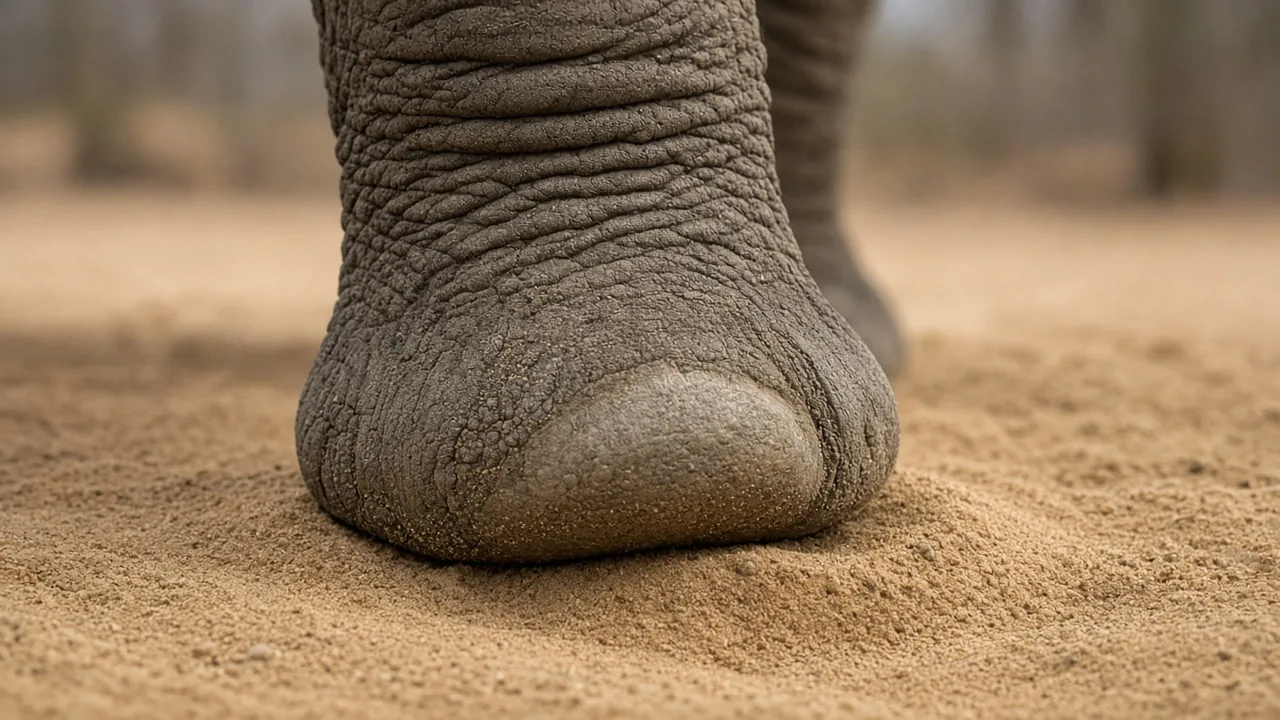
Five toes, but fewer toenails
Every elephant has five toes in the bones of each foot. Elephant Aid International and the San Diego Zoo Wildlife Alliance fact sheet agree on that. They do not agree on a single nail count, because not every toe shows a nail, and the visible number changes by species and by individual.
The fact sheet, which cites Tassy and Shoshani (2013) and Nowak (2018), gives African savanna elephants 4 to 5 nails on the front feet and 3 to 5 on the hind feet, and African forest elephants 5 on the front and 4 to 5 on the hind. Elephant Aid International states a tighter typical count: forest elephants and Asian elephants with 5 nails on the front feet and 4 on the back, and savanna elephants with 4, or sometimes 5, in front and 3 behind. The African fact sheet does not give an Asian nail count, so the Asian row below rests on Elephant Aid International alone.
| Species | Front nails | Hind nails | What the sources actually say |
|---|---|---|---|
| African savanna | 4 to 5 | 3 to 5 | Fact sheet range. Elephant Aid International's typical count is 4, sometimes 5, in front and 3 behind. |
| African forest | 5 | 4 to 5 | Fact sheet range. Elephant Aid International gives 5 in front and 4 behind. |
| Asian | 5 | 4 | Elephant Aid International. Not covered on the African fact sheet. |
The same fact sheet notes that Parker and Graham (2017) found 5 front nails and 4 hind nails the most common pattern in three East African populations. Those are savanna elephants, so that common pattern sits inside the savanna range, and it is higher than the "about 3 behind" figure Elephant Aid International uses as typical. Nails are a clue when you are sorting species. Ears, tusks, the shape of the back and the trunk tip, set out on the African versus Asian comparison, separate the species more reliably than a nail count on one animal.
Why elephants walk on tiptoe
Both sources say elephants walk on tiptoe, with the toe bones angled down rather than lying flat. The fact sheet cites Hutchinson and colleagues (2011) for that stance. Elephant Aid International compares the arrangement to the feet of dogs and cats, with weight carried through the toes. Behind and beneath the toe bones sits a thick, fibrous, fatty pad. The anatomy page puts that pad under the pillar legs.
The pad spreads the elephant's weight, absorbs shock when the foot lands and, according to Elephant Aid International, helps elephants move quietly. The pad expands as the foot is put down. Our article on why elephants can walk so quietly goes into the cushion in more detail, and how fast an elephant can run covers what those feet do at speed.
The sixth toe is not a nail
Elephant Aid International's foot structure page, rechecked on 20 November 2026, describes cartilage supports, sometimes called predigits or a sixth toe, that brace the fatty cushion and help spread weight. They are not true toes with nails. That is why an elephant can have five toe bones and only three, four or five nails.
More than a cushion
The fact sheet says the large wedge shaped fat pads absorb shock and likely help with sensory signals such as vibrations and pressure, citing Weissengruber and colleagues (2006) and Panagiotopoulou and colleagues (2016). Elephant Aid International adds ridges on the soles that give traction on slippery or uneven ground, and says footpads and nails keep growing throughout an elephant's life.
Why foot health matters
Elephant Aid International calls foot health a serious issue for elephants in captivity. It says inactivity and long periods standing or walking on hard surfaces such as concrete can cause thin, uneven, bruised pads and cracked nails, which can lead to infection. That is a report about husbandry, not a care guide, and this page is not veterinary advice. If you are choosing where to see elephants, our elephant sanctuary checklist asks about ground surfaces and foot care without rating any named place.
Frequently asked questions
How many toes does an elephant have?
Five in each foot, in the skeleton. Not all five have a visible nail.
How many toenails do Asian elephants have?
Elephant Aid International gives five on each front foot and four on each back foot.
How many toenails do African savanna elephants have?
The San Diego Zoo fact sheet gives 4 to 5 nails on each front foot and 3 to 5 on each hind foot. Elephant Aid International's typical count is 4, sometimes 5, in front and about 3 behind. Counts vary between individuals.
Do elephants really walk on tiptoe?
Yes. Their toe bones angle downward and a thick fatty pad sits behind and beneath them.
Do elephant toenails keep growing?
Elephant Aid International says footpads and nails continue to grow throughout an elephant's lifetime.
Sources
Cite this page
APA
TuskWise. (2026, November 20). How many toes and toenails do elephants have? https://tuskwise.com/blog/how-many-toes-and-toenails-do-elephants-have.html
MLA
“How many toes and toenails do elephants have?” TuskWise, 20 Nov. 2026, tuskwise.com/blog/how-many-toes-and-toenails-do-elephants-have.html.
Chicago
TuskWise. “How many toes and toenails do elephants have?” TuskWise. Last modified November 20, 2026. https://tuskwise.com/blog/how-many-toes-and-toenails-do-elephants-have.html.