Why are some elephants born without tusks?
A small share of elephants are naturally born without tusks, a trait that runs in families. Where poaching for ivory was heavy, that share has jumped, because tuskless elephants were the ones left alive to breed. In Mozambique's Gorongosa National Park, about half the females that survived the civil war had no tusks, and a 2021 study in Science traced the trait to the X chromosome. In one South African park, almost every female is tuskless for a different reason: a tiny, isolated founding population.
The short answer
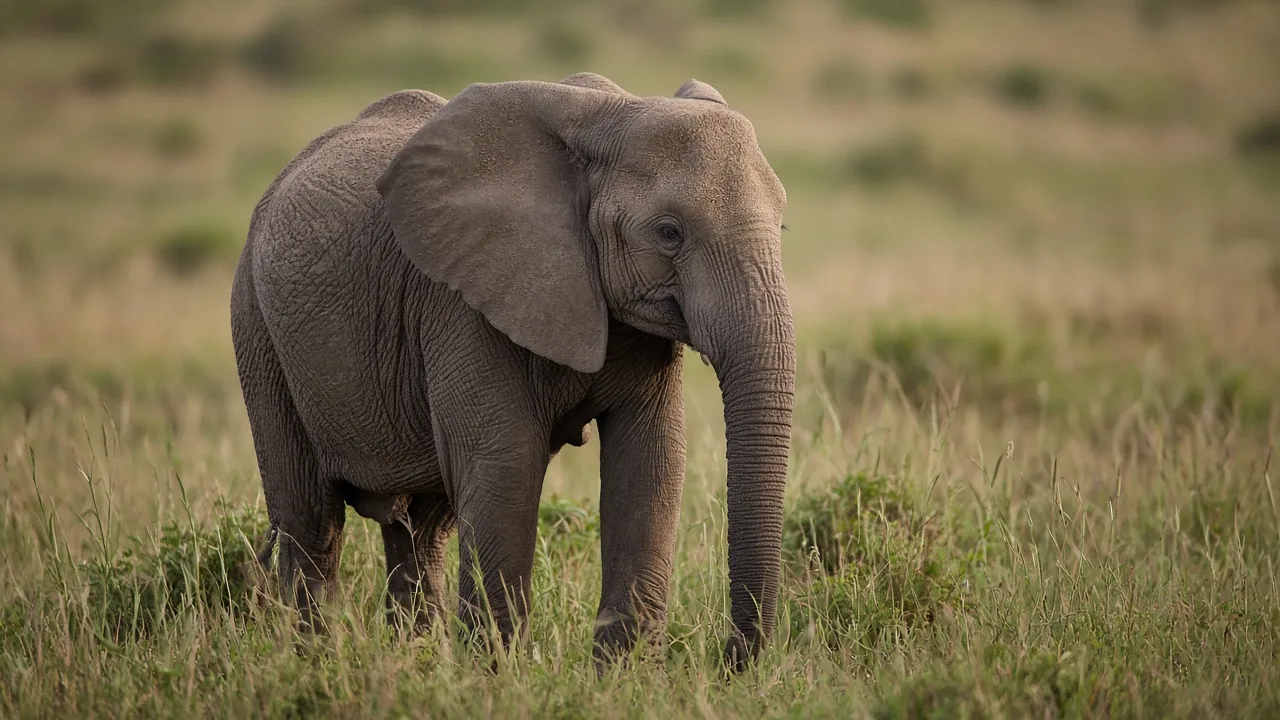
Some elephants are simply born without tusks. It is an inherited trait, and in a healthy African population only a small minority of animals carry it. But tusks are what poachers want, so in places where ivory hunting was intense, elephants with tusks were killed and tuskless ones were more likely to survive and breed. Over a few decades, that pushed tusklessness up sharply. It is one of the clearest examples of people driving rapid change in a wild animal, and it shows up in several separate studies across Africa.
What tusks are and what elephants use them for
Tusks are enlarged incisor teeth that keep growing throughout an elephant's life. As our anatomy guide explains, they are made mostly of dentine, the material sold as ivory. Elephants use them to dig for water, salt and roots, to strip bark from trees, to lift and move objects, and in fights between males. In African elephants both sexes normally grow tusks. Asian elephants are different: females usually have none or only small tushes, and some males are tuskless as well. Our African vs Asian elephant comparison covers these differences in more detail.
Gorongosa: war, poaching and a genetic signal
The strongest evidence comes from Gorongosa National Park in Mozambique. During the country's civil war, from 1977 to 1992, armies on both sides targeted elephants for their ivory, and the park's elephant population fell by about 90 percent.
In 2021 Shane Campbell-Staton, Ryan Long, Robert Pringle and colleagues, including elephant researcher Joyce Poole, published an analysis in Science. Using old film footage and field records, they estimated that about 18.5 percent of adult females were tuskless before the war. Among adult females after the war, the figure was about 51 percent, a nearly threefold rise. Their models showed that a jump this large was very unlikely to happen by chance and was consistent with strong selection by poachers.
The team then looked at families and genomes. Tusklessness appeared only in females, and tuskless mothers produced fewer sons than expected. That pattern fits a dominant trait carried on the X chromosome that is fatal to males who inherit it. When they compared genomes of tusked and tuskless females, they found signs of recent selection on two genes linked to tooth development: AMELX on the X chromosome and MEP1a on another chromosome. The exact mechanism is still unresolved. The work does not mean elephants "chose" to lose tusks. It means poaching removed tusked animals so quickly that a rare inherited variant became common.
Zambia: a rise recorded decades earlier
Gorongosa was not the first warning. In 1995 Hugo Jachmann, P. S. M. Berry and H. Imae reported in the African Journal of Ecology that in South Luangwa National Park and the neighbouring Lupande area of Zambia, the share of adult females without tusks rose from 10.5 percent in 1969 to 38.2 percent in 1989. They linked the change to selective illegal ivory hunting and noted that tusklessness ran in families and appeared to be sex-linked. Between 1989 and 1993 the figure fell back to 28.7 percent, partly because tusked females moved in from surrounding areas once poaching eased. That detail matters: it shows that the trend can reverse when elephants can move freely between protected areas.
Kenya: tusks are getting smaller, not just missing
Poaching does not only favor animals with no tusks. It also favors those with small ones. A 2015 study in Ecology and Evolution by Patrick Chiyo, Vincent Obanda and David Korir compared Kenyan elephants measured in 1966 to 1968, before the heavy poaching of the late 1970s and 1980s, with survivors and with elephants born during the population's recovery in the 1990s. Adjusting for body size, tusk length had fallen by about 21 percent in males and 27 percent in females born during recovery. Tusk size was similar within social groups, which suggests it is at least partly inherited and that poachers' preference for big tuskers may be reshaping the population.
Addo: almost all females tuskless, for a different reason
Not every tuskless population is the product of poaching. In South Africa's Addo Elephant National Park, Anna Whitehouse reported in the Journal of Zoology in 2002 that 98 percent of the 174 females were tuskless. Using long-term records, she found that neither selective hunting nor the local vegetation could explain this. Addo's elephants descend from a very small, isolated group that survived intense persecution in the early 20th century. In such a tiny population, a trait can spread purely by chance, a process called genetic drift. Addo is a reminder that small, cut-off populations lose genetic variety, one of the long-term risks discussed on our conservation page.
Why tusklessness matters
A tuskless elephant can live a normal life, but it does some jobs differently. Tusks help elephants break branches, debark trees and dig, and those actions shape savanna and forest habitats for many other species. Researchers working in Gorongosa have suggested that a population with fewer tusks may feed in different ways, which could gradually change the park's vegetation. A missing tusk is a small change for one animal and a potentially large one for an ecosystem.
The good news is that the trend is not fixed. In Gorongosa the elephant population has been recovering under protection, and the Luangwa data show that tusked animals can return when populations reconnect. Reducing demand for ivory and stopping poaching remain the most direct ways to let natural tusk patterns recover. For the bigger picture of elephant numbers, see how many elephants are left, and for how poaching shortens lives, see how long elephants live.
The bottom line
Some elephants are born without tusks because of an inherited trait that has always existed at low levels. Heavy ivory poaching made it far more common in parts of Mozambique and Zambia, and it has shrunk tusk size in Kenya, because poachers removed the tusked animals first. In isolated parks like Addo, chance alone pushed tusklessness to nearly every female. Either way, the elephants we see today carry the marks of how people have treated them.
Frequently asked questions
Is it normal for an elephant to have no tusks?
A small minority of African elephants are naturally tuskless, and the trait runs in families. Among Asian elephants it is the norm for females, which have no tusks or only short tushes, and some Asian males are tuskless too. What is not normal is the very high rate of tusklessness now seen in some heavily poached African populations.
Did poaching cause elephants to evolve without tusks?
Studies suggest poaching made an existing trait much more common. In Gorongosa, Mozambique, the share of tuskless females rose from roughly 18.5 percent before the civil war to about 51 percent among survivors, and a 2021 Science study found genetic signs of selection. In Zambia's Luangwa Valley, tuskless adult females rose from 10.5 percent in 1969 to 38.2 percent in 1989.
Why are tuskless elephants almost always female?
The Gorongosa study found the trait behaves as if it is carried on the X chromosome and is dominant, and that it seems to be lethal to males that inherit it. Daughters of tuskless mothers were often tuskless, and tuskless mothers had fewer sons than expected.
Do elephants need their tusks?
Tusks are tools. Elephants use them to dig for water and minerals, strip bark, move obstacles and fight. Tuskless elephants survive, but researchers expect changes in how they feed and shape their habitat, so a rise in tusklessness can ripple through an ecosystem.
Sources
- Campbell-Staton, S. C., Arnold, B. J., Gonçalves, D., Granli, P., Poole, J., Long, R. A. and Pringle, R. M. (2021). Ivory poaching and the rapid evolution of tusklessness in African elephants. Science 374, 483 to 487. DOI 10.1126/science.abe7389
- Jachmann, H., Berry, P. S. M. and Imae, H. (1995). Tusklessness in African elephants: a future trend. African Journal of Ecology 33, 230 to 235. DOI 10.1111/j.1365-2028.1995.tb00800.x
- Chiyo, P. I., Obanda, V. and Korir, D. K. (2015). Illegal tusk harvest and the decline of tusk size in the African elephant. Ecology and Evolution 5, 5216 to 5229. DOI 10.1002/ece3.1769
- Whitehouse, A. M. (2002). Tusklessness in the elephant population of the Addo Elephant National Park, South Africa. Journal of Zoology 257, 249 to 254. DOI 10.1017/S0952836902000845
Cite this page
APA
TuskWise. (2026, October 18). Why are some elephants born without tusks? https://tuskwise.com/blog/why-are-some-elephants-born-without-tusks.html
MLA
“Why are some elephants born without tusks?” TuskWise, 18 Oct. 2026, tuskwise.com/blog/why-are-some-elephants-born-without-tusks.html.
Chicago
TuskWise. “Why are some elephants born without tusks?” TuskWise. Last modified October 18, 2026. https://tuskwise.com/blog/why-are-some-elephants-born-without-tusks.html.