How many teeth do elephants have?
Over its lifetime an elephant grows 26 teeth: two tusks and 24 cheek teeth (molars and premolars). The cheek teeth come in six per side in both the upper and lower jaw, but an elephant only ever uses one or two of them on each side at a time. Instead of new teeth pushing up from below, as in humans, each new tooth moves forward from the back of the jaw as the worn one in front breaks away, like a slow conveyor belt.
The short answer
An elephant grows 26 teeth over its whole life: two tusks and 24 cheek teeth. The cheek teeth, the big ridged grinders at the back of the mouth, come in a series of six in each half of the upper jaw and six in each half of the lower jaw. But they never all appear at once. At any moment an elephant is using only one or two cheek teeth on each side of each jaw, so an adult usually has between four and eight grinding teeth in its mouth, plus its tusks.
Tusks are teeth too
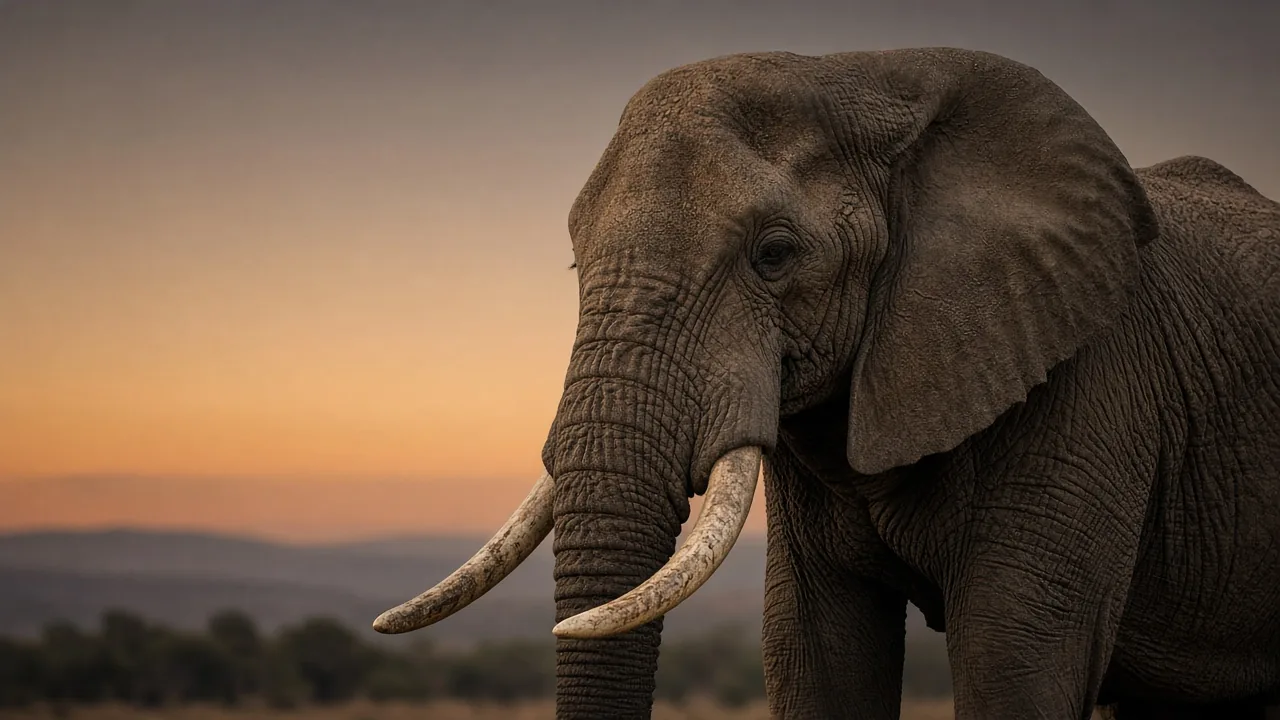
Elephant tusks are enlarged upper incisors, the same kind of tooth as your front teeth. They keep growing throughout life and are used for digging, stripping bark, lifting and fighting. Elephants have no other front teeth and no canines, so tusks play no part in chewing. Some elephants never grow tusks at all, a trait that has become much more common where ivory poaching was intense; see why some elephants are born without tusks.
A conveyor belt of molars
Most mammals replace teeth vertically: an adult tooth grows up beneath a baby tooth and pushes it out. Elephants do something different. Their cheek teeth form at the back of the jaw and move slowly forwards as they come into use. As the front tooth wears down, it is pushed forward and breaks away in pieces, and the next tooth behind it takes over. Each tooth in the series is bigger than the one before, matching the growing animal and its growing appetite.
Scientists number these six teeth in each jaw quadrant with Roman numerals I to VI, or M1 to M6. The first three are often called milk molars or deciduous premolars, and the last three true molars, but they all follow the same forward-moving pattern. The grinding surface of each tooth is made of a row of enamel ridges, or plates, that act like a file on tough grass, bark and branches. That is how an elephant manages to process the enormous amount of plant food described in how much elephants eat and drink.
Reading an elephant's age from its teeth
Because the six teeth arrive and wear down in a fixed order, they make a natural clock. In a classic 1966 study, biologist Richard Laws examined 385 lower jaws of African elephants from western Uganda and described 30 age groups based on how far each of the six teeth had erupted and worn. He checked that teeth were identified correctly by measuring their length and width: plotted against each other, the six teeth fell into six well-defined clusters. Laws also recorded four jaws with an unusual seventh molar, and his age estimates pointed to an upper age limit of about 60 years.
Laws had to estimate the ages for his groups, because nobody knew the birth dates of those elephants. Decades later, Phyllis Lee, Cynthia Moss and colleagues tested his criteria against elephants from Amboseli National Park in Kenya, where individuals have been followed since birth. Writing in 2012, they concluded that the technique "remains a robust and useful mechanism for age determination", while suggesting revisions to the oldest age categories. They also found that elephants of the same known age differed in how fast their teeth wore and moved, so age estimates from teeth should carry a margin of error, and that the fourth and fifth teeth were sometimes confused with each other.
Teeth in Asian elephants
Asian elephants follow the same pattern of six cheek teeth per quadrant. In a 1988 study, V. Louise Roth and Jeheskel Shoshani measured teeth from more than 100 museum specimens of Elephas maximus to set size ranges for each of the six tooth categories. They found that elephant teeth vary greatly and overlap in size, because the size, shape and position of each tooth changes as it forms, erupts, wears and moves through the jaw. Even so, using three or more measurements together allowed reliable identification of which tooth is which, and an estimate of the animal's age in years. The shape of the molar ridges also differs between Asian and African elephants, one of the features covered in our African vs Asian elephant comparison.
When the last tooth wears out
After the sixth cheek tooth there are no more replacements. Once it has worn down, an elephant can no longer grind tough food well, and very old elephants are thought to lose condition partly for this reason, often staying near swamps and rivers where vegetation is softer. This limit on teeth helps explain why elephants rarely live beyond their sixties in the wild. Read more in how long elephants live.
The bottom line
Elephants have 26 teeth in a lifetime: two tusks and 24 cheek teeth, six per half-jaw, but only a handful are in use at any time. New teeth arrive from the back like a conveyor belt, their wear lets scientists estimate an elephant's age, and when the last one is gone, an elephant's long life is drawing to a close. For more on how elephant bodies work, see the elephant anatomy guide or the elephant FAQ.
Frequently asked questions
How many teeth does an elephant have?
An elephant grows 26 teeth in its lifetime: two tusks, which are enlarged upper incisors, and 24 cheek teeth, six in each half of the upper and lower jaws. At any one time, though, only one or two cheek teeth per side are in use, so an adult typically has just four to eight grinding teeth in its mouth.
Are elephant tusks teeth?
Yes. Tusks are greatly enlarged upper incisor teeth that keep growing throughout life. Elephants have no other front teeth; all their chewing is done by the large cheek teeth at the back of the mouth.
How do elephants replace their teeth?
Elephant cheek teeth are replaced horizontally. Each new tooth forms at the back of the jaw and slowly moves forward as it wears, while the worn front tooth breaks off in pieces. Each elephant gets six such teeth per jaw quadrant in its life, each larger than the one before.
What happens when an elephant runs out of teeth?
The sixth cheek tooth is the last one. Once it is worn down, an elephant cannot chew tough plants efficiently, and very old elephants are thought to lose condition and die partly for this reason. The tooth sequence is one reason the natural lifespan of elephants tops out at around 60 to 70 years.
Can you tell an elephant's age from its teeth?
Yes. In 1966 biologist Richard Laws described 30 age groups for African elephants based on which of the six teeth are erupted and how worn they are. A 2012 test against Amboseli elephants whose birth dates were known found the method robust, though the oldest categories needed revision and individuals of the same age varied.
Do Asian and African elephants have the same teeth?
Both have the same pattern of two tusks and six cheek teeth per jaw quadrant, replaced from behind. Their molars differ in detail, especially in the shape and number of the enamel ridges on the grinding surface, which is one way scientists tell the species apart, including in fossils.
Sources
- Laws, R. M. (1966). Age criteria for the African elephant. East African Wildlife Journal (now African Journal of Ecology) 4, 1 to 37. DOI 10.1111/j.1365-2028.1966.tb00878.x
- Lee, P. C., Sayialel, S., Lindsay, W. K. and Moss, C. J. (2012). African elephant age determination from teeth: validation from known individuals. African Journal of Ecology 50, 9 to 20. DOI 10.1111/j.1365-2028.2011.01286.x
- Roth, V. L. and Shoshani, J. (1988). Dental identification and age determination in Elephas maximus. Journal of Zoology 214, 567 to 588. DOI 10.1111/j.1469-7998.1988.tb03760.x
Cite this page
APA
TuskWise. (2026, October 27). How many teeth do elephants have? https://tuskwise.com/blog/how-many-teeth-do-elephants-have.html
MLA
“How many teeth do elephants have?” TuskWise, 27 Oct. 2026, tuskwise.com/blog/how-many-teeth-do-elephants-have.html.
Chicago
TuskWise. “How many teeth do elephants have?” TuskWise. Last modified October 27, 2026. https://tuskwise.com/blog/how-many-teeth-do-elephants-have.html.